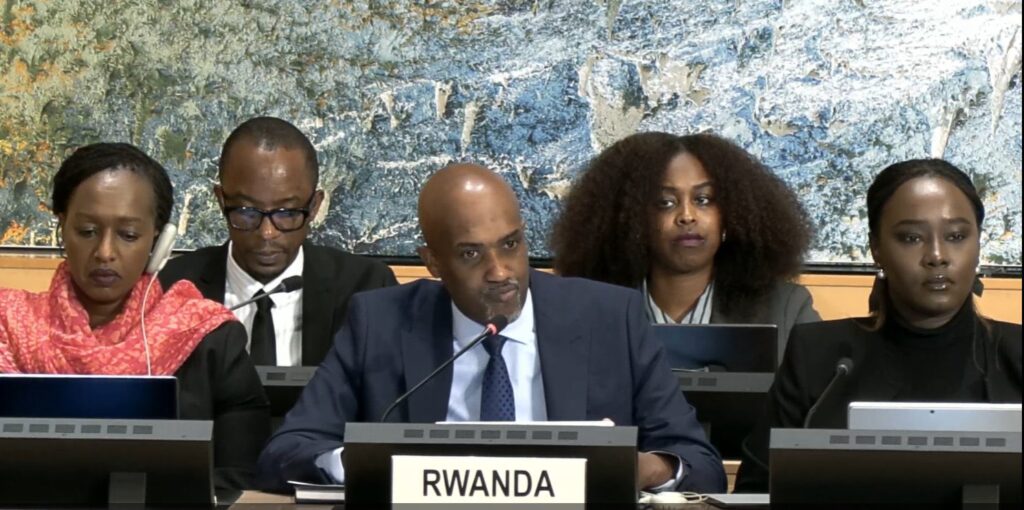
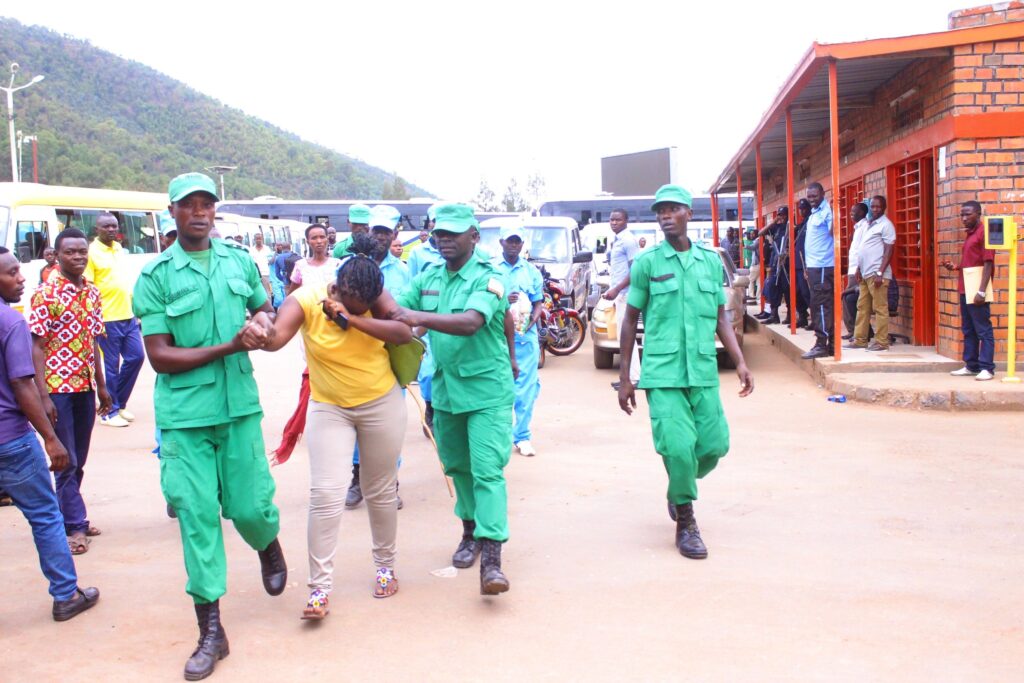
Rwanda's delegation at UN Human Rights Council on January 21, 2026. Courtesy photo
Rwanda’s human rights record came under scrutiny during the country’s Universal Periodic Review at the United Nations Human Rights Council in Geneva with States demanding actions to end ill treatment in detentions, extra-judicial killings and a wide range of rights abuses.
States pointed to broader concerns around threats against civil society, journalists, political opponents and human rights defenders, as well as violations of freedoms of expression and assembly.
The assessment of Rwanda’s human rights record, a fourth one by the UN since 2011, comes at the backdrop of years marked by scrutiny over government’s alleged rights violations in the country and beyond in light of the war in the East of the neighbouring Democratic Republic of Congo where it is suspected to back a rebel movement fighting the government.
Besides, hopes for a safe, independent and accountable environment for journalists, civil society and political actors have eroded over time amid reports of harassment, arrests, detention and threats against media workers and critics and opposition politicians.
Rwandan authorities also came under increased scrutiny lately over nationwide closure of churches, which weighed down right to freedom of religion or belief in the country, said UN rights council members at the review held on 21 January in Geneva.
Despite Rwanda possessing a human rights commission created to act as a rights watchdog, member States raised doubts about its independence.
“Review your selection procedures for members of your National Human Rights Commission to guarantee their independence when they review complaints of extrajudicial execution enforce disappearances, torture, arbitrary detention and restrictions on freedom of expression,” Republic of Chile’s representative told Rwandan authorities.
Several countries urged Rwanda to, among other things, take measures to improve the human rights situation in places of detention and allow visits by independent local and international bodies.
On its part, Sierra Leone urged Rwanda to conduct independent and effective investigation into allegations of judicial executions and enforced disappearances and torture, and to take measures to end all forms of violence.
Sierra Leone was joined by South Africa, Slovenia, Norway, Sweden, among others to urge Rwandan authorities to ensure accountability of perpetrators and to deliver safe and enabling environment for journalists and human rights defenders.
“We recommend Rwanda to strengthen efforts to prevent torture and other forms of ill treatment and ensure prompt and credible investigations into allegation of torture, including deaths in custody to ensure that all arrest procedures uphold due process guarantees and are conducted with full transparency,” Belgium representative said.
‘No evidence‘
Rwanda’s Minister of Justice and Attorney General, Emmanuel Ugirashebuja, who led the Rwanda delegation dismissed claims of targeting journalists, civil society organizations and rights violations in other areas, including extra judicial killings as unfounded.
He said the claims were mere generalities of which member States do not provide evidence.
“Whenever serious allegations are made, then serious evidence has to be produced so that investigative bodies do their job. So we hope that any of the delegates who has very compelling evidence to share it with us, so that the investigative bodies can carry out their constitutionally mandated activities,” he told the UN rights council.
The minister also rejected review by States pointing to concerns over Rwanda’s involvement in human rights abuses in eastern Congo. He said Rwanda did not expect to be reviewed on areas where it has no effective jurisdiction.
Other recommendations sent the Rwandan delegation’s way were largely those urging the government to ratify the Rome Statute of the International Criminal Court (ICC) which deals with crimes of genocide, crimes against humanity, war crimes, and the crime of aggression.
There is also the International Convention for the protection of all people against enforced disappearances.
Rwandan authorities indicated that these treaties were not priority for the country at the moment with Mr. Ugirashebuja indicating that the government would only decide to ratify them if found necessary through its internal review mechanisms.