YEARATWAR: Families of fallen Rwandan soldiers wait for answers
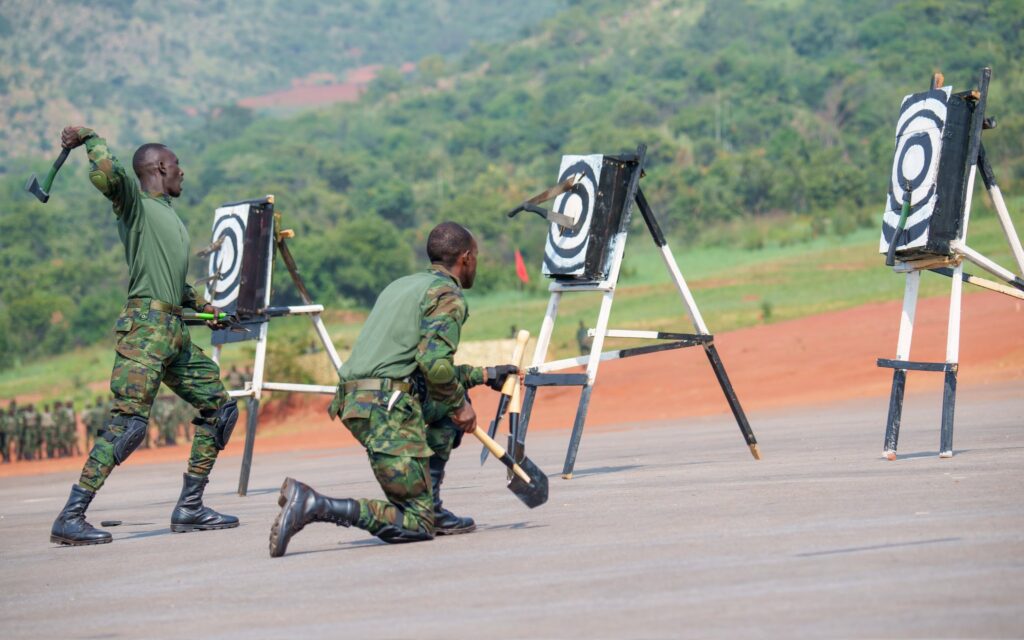
Rwandan soldiers demonstrate combat skills at training. Estimated 5,000 to 7,000 soldiers were sent to the battlefield as fighting raged between rebels and the Congo government army. Courtsey Photo
President Paul Kagame of Rwanda was upbeat about 2026 in New Year address to the nation, except for one thing: prospects of bringing the war with Democratic Republic of Congo to an end.
Despite expressing commitment to the two countries’ peace accord brokered by U.S. President Donald Trump, the Rwandan ruler still holds grudges against DR Congo government over what he called State-supported extremism. He also warned that he will not tolerate “any threat to the peace and security of our people”.
The peace accord signed with his Congolese counterpart Felix Tshisekedi on 4 December in Washington already suffered a setback when fresh waves of fighting erupted just days after the signing ceremony with Rwanda-backed M23 rebels capturing Uvira, a key town.
The rebels later announced withdrawal from the City when the U.S. piled pressure on Kigali. Mr. Kagame avoided commenting on these latest developments in his six-minute-long pre-recorded address aired on 31 December, in which he largely touched key highlights for the year and prospects ahead.
But the Rwandan ruler tackled none of the big questions on the minds of many Rwandans regarding the extent of his regime’s role in the Congo war, and especially those concerning the human and material cost of the conflict so far responsible for one of the world’s largest displacement and humanitarian crises.
Narrative
The government kept Rwandans in the dark about military deployments into the Congo, and has publicly denied any involvement in the war to date. Authorities maintained this narrative even as numbers of soldiers sent to the battlefield rose significantly in recent months with battle deaths and casualties being received at Rwandan military facilities.
When Rwanda’s role caught the attention of international media and rights organisations, burials of fallen soldiers were strictly controlled. Families who received bodies of loved ones in coffins for burials could not ask questions. Victims received no official recognition or military funerals in attempts to avoid scrutiny and to suppress voices demanding accountability, according to the affected families.
It was no different for soldiers who were repatriated as casualties or traumatised who were kept at military health facilities with tightly controlled information flow during visits by relatives.
In one case, a mother fell into comma when news of the death of her son at the battlefield broke last November. She never recovered. It was her only child having lost all the others in previous cycles of war. Nothing had prepared her for the tragedy as her son had been in good health and not known to be on any of the country’s official deployment to peacekeeping missions abroad.
At his funeral, eulogies had to make no mention of the circumstances of his death, the family was told. Her mother was buried the following day. The family is one of many seeking the truth. They gave their children to the nation, but the government kept them in the dark about their deployment in a foreign land and remains silent about the circumstances of their deaths.
The constitution allows Kagame, who is also the Commander-in-Chief of the Rwanda Defence Force (RDF), to declare war with approval of Parliament. However, lawmakers, like the general Rwandan public, read in the international press about their country being at war. Locally, government-sanctioned narrative dominate local media and national conversations.
It is hard to tell whether or not Rwandan citizens would be in support of Kagame’s war enterprise if they were to have their say.
A local political analyst opined, however, that this being a dictatorial system, public opinion is either suppressed or ignored. Either way it won’t bother the ruling elite. Efforts have instead shifted towards dealing with external pressure.
War crimes
But the accountability questions refuse to go away as Rwandan authorities continued to send more forces, including new recruits and reservists, to the battlefield. Further concerns rose in light of alleged war crimes and crimes against humanity committed in the conflict zones.
The Rwandan regime is said to have sent estimated 5,000 to 7,000 forces to the battlefield as of early December, a number that increased significantly at the height of most recent fighting that led to capture of more territories, U.S. Ambassador to the United Nations Mike Waltz told the U.N. Security Council on December 12.
With reports equally pointing to more rebel support in material logistics, weaponry and training, many expected Kagame to come clean on Rwanda’s role in his New Year speech.
On December 29, his office released the end-of-year message in which he heaped praises on RDF (the army) but still fell short of addressing the war issue, justification and the extent of its toll.
“To the mourning families who have lost loved ones in service, I honor your sacrifice and assure you that we will always stand by your side,” read part of Kagame’s message which was shared across the online platforms of the Ministry of Defense.
The government had previously attempted, through its web of information mercenaries, to justify its alleged role in the Congo war using the notion that colonial borders were incorrectly drawn, thus a huge chunk of what used to be Rwandan territories were lost to the Congo.
They further indicated that the Congolese government, in collaboration with FDLR, a militia linked to the 1994 Genocide, habour the agenda of exterminating Tutsi ethnic people in those territories. This, they said, makes it mandatory for Rwanda to do anything in its powers to ‘protect’ them.
But soon after international pressure mounted on Kigali over supporting rebels fighting the Government of Kinshasa, followed by sanctions against a number of Rwandan Government and military officials by Western countries, the narrative shifted to indicate to the Rwandan public that all it has done was putting up defensive measures along Rwandan borders without going into details of what that entails.
Meanwhile, this being the fifth time Rwanda is involved in fighting in the Congo under the rule of Kagame, analysts link the war in the natural-resource rich part of the Congo to Kigali’s strategy to keep the minerals flowing into Rwandan ruling elites’ businesses and allies in the West expecting government legitimacy in return.